
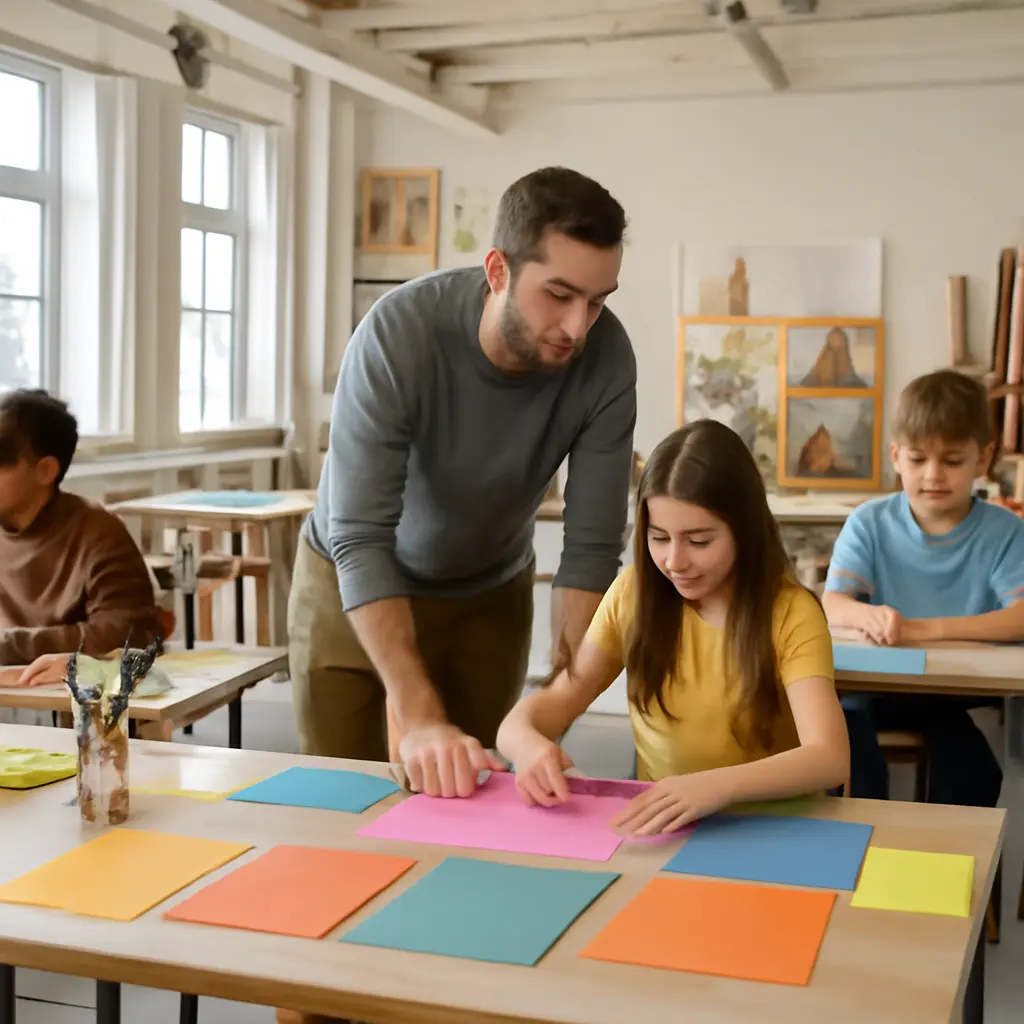
What Happens When Students Dive Into Visual Arts, Music, and Theater
When students dive into visual arts, music, and theater, they gain more than instruction in painting, playing an instrument, or performing: they practice creative thinking, communication, collaboration, and persistence. The National Endowment for the Arts has reported associations between arts participation and positive academic and social outcomes, while research reviews caution that effects vary by program and study design. Together, evidence on arts education, the distinct benefits of each discipline, and practical examples show why meaningful access matters—and why arts learning is valuable in its own right, not only as a means to improve other outcomes.
Arts education develops skills through creative practice
Arts education is structured learning in disciplines such as visual arts, music, and theater. The National Endowment for the Arts describes arts education as learning that develops artistic skills and knowledge through engagement with the arts. In practice, students observe, make, rehearse, interpret, and share work. These activities connect technical choices with personal expression and give learners repeated opportunities to revise ideas in response to feedback.
The National Core Arts Standards organize learning around creating, performing or presenting, and responding or connecting. Those processes provide a useful framework for understanding the subject’s main forms: making visual work, developing musical understanding and performance, and building theatrical work through acting, design, and production. The disciplines differ in materials and methods, but all require attention, experimentation, and reflection.
Creative thinking and problem-solving
Creative thinking means generating and developing ideas rather than simply reproducing a model. A student composing a melody, revising a scene, or choosing materials for a sculpture makes decisions, tests possibilities, and adjusts the work toward an intended effect. The Organisation for Economic Co-operation and Development’s PISA framework treats creative thinking as the ability to generate, evaluate, and improve ideas—capacities that arts tasks can let students practice in concrete ways.
Persistence, reflection, and feedback
Artistic work commonly involves drafts, rehearsal, critique, and revision. Students learn to distinguish a first attempt from a finished piece and to use feedback to make purposeful changes. This does not mean every arts activity automatically builds resilience; the experience depends on thoughtful teaching, appropriate challenge, and a classroom climate in which experimentation is safe. When those conditions are present, students can see improvement as a process rather than an instant result.
Communication and collaboration
Arts learning also gives students ways to communicate without relying solely on written or spoken explanation. Images, sound, movement, and dramatic action can express perspectives and emotions. Group performances, ensemble playing, murals, and production crews require participants to listen, coordinate, share responsibility, and work toward a common outcome. These are discipline-specific practices as well as transferable social skills.
Visual arts build observation and visual literacy
Visual arts education includes drawing, painting, sculpture, photography, printmaking, and digital media. Visual literacy—the ability to interpret and communicate meaning through images—is central to this work. Students learn to notice details, understand how elements such as color and composition shape meaning, and make informed choices about materials and technique.
From observation to interpretation
Drawing from observation can train students to look carefully at proportion, texture, light, and spatial relationships. Analyzing artworks adds another layer: students consider how an image reflects its maker, culture, historical moment, or intended audience. The National Core Arts Standards include interpreting and evaluating artistic work, making analysis part of arts learning rather than treating artmaking as the only objective.
Material choices and experimentation
Visual artists work with materials that have different possibilities and limits. A student creating a collage, for example, must consider how scale, texture, placement, and contrast influence what viewers notice. Digital art introduces further choices about layers, editing, and media. Experimentation helps students understand that a technique is not just a procedure: it can change the meaning and impact of the work.
A connection to other subjects
Visual arts can offer practical connections to history, science, and mathematics. Students might study patterns in nature, use geometry in design, or examine how artists respond to historical events. These connections can deepen understanding, but the arts should not have to justify their place only through benefits to other subjects. Artistic knowledge, cultural expression, and the experience of making are meaningful outcomes themselves.
Music develops listening, timing, and ensemble skills
Music education involves singing, playing instruments, composing, improvising, listening, and learning about musical traditions. The National Core Arts Standards frame musical learning through creating, performing, responding, and connecting. Students work with rhythm, pitch, melody, harmony, timbre, and form while learning how sound communicates across styles and cultures.
Practice and musical understanding
Learning an instrument or developing a voice combines physical coordination with focused listening. Students interpret notation or learn by ear, practice sections, and bring them together into a complete piece. Research on music and academic achievement is extensive but should be interpreted carefully: a 2020 review by Giovanni Sala and Fernand Gobet in Memory & Cognition found that claims of broad cognitive transfer from music training are not consistently supported by rigorous studies. The educational case for music also rests on musical understanding, expression, cultural knowledge, and accomplishment within the discipline.
Ensemble performance and coordination
Ensemble playing requires students to maintain their own parts while responding to other musicians. They attend to tempo, dynamics, entrances, and balance, often adjusting in real time. A choir, band, or small ensemble therefore provides a clear setting for shared responsibility: the group’s sound depends on individuals contributing while remaining attentive to one another.
Music as cultural knowledge
Music carries histories, identities, and traditions. Studying music from different communities can help students understand how instruments, styles, and performance practices develop in specific contexts. Effective teaching approaches traditions with care, gives context rather than treating music as a detached sample, and recognizes the communities that sustain those practices.
Theater builds interpretation, expression, and teamwork
Theater education includes acting, improvisation, script analysis, directing, stage management, and design for scenery, costumes, lighting, and sound. Students interpret texts and situations, develop characters, and communicate meaning through voice, movement, space, and visual choices. The National Core Arts Standards describe theater learning through creating, performing, responding, and connecting, reflecting the full process from initial idea to audience experience.
Role-play and perspective-taking
In role-play, students explore a character’s goals, circumstances, and point of view. This requires interpreting evidence in a script or scenario and making choices about how a character might speak and move. A 2019 meta-analysis by Michael W. D. T. Goldstein and colleagues, published in Review of Educational Research, found that pretend play can support some aspects of children’s social competence, while emphasizing that the strength of evidence differs across outcomes. Theater offers structured opportunities to practice perspective-taking, but no single performance guarantees a particular social result.
Production depends on collaboration
A theatrical production is a coordinated effort among performers and behind-the-scenes teams. Actors rely on cues; stage managers track transitions; designers and technicians shape what the audience sees and hears. This makes theater a particularly visible example of interdependent work, where planning, communication, and careful execution matter alongside creative ideas.
Public performance and communication
Performing for an audience gives students experience organizing ideas for others and responding to the demands of live communication. Rehearsal can help students become more familiar with material, timing, and presentation. However, participation should be supportive and flexible: students can contribute through acting, writing, design, or technical production, and educators should avoid treating public performance as the only valid measure of learning.
Research points to potential benefits—and important limits
Arts education research reports associations with academic engagement, school participation, and social outcomes, but correlation is not proof that arts classes alone cause those outcomes. Students’ access to programs may be related to school resources, family circumstances, or other opportunities. The National Endowment for the Arts’ 2012 report The Arts and Achievement in At-Risk Youth found that students with high arts involvement were more likely than peers with low arts involvement to show positive academic and civic outcomes. The report documents associations over time; it should not be read as evidence that arts participation by itself produced every difference.
The Education Commission of the States’ 2019 review of state policies also illustrates that arts access is shaped by education systems: states differ in their arts standards, graduation requirements, and approaches to accountability. A school may value the arts but still face constraints in staffing, schedules, facilities, or funding. As a result, the opportunity to participate is not necessarily equal for all students.
A useful accompanying graphic would compare access to arts instruction by school level, location, and student group, using consistent data from a source such as the National Center for Education Statistics. Such a chart should distinguish access to classes from participation in extracurricular activities and should state the year and population measured.
Equitable access makes arts learning more meaningful
Arts opportunities depend on more than a course appearing in a catalog. Students need qualified educators, appropriate materials, accessible spaces, and schedules that do not systematically exclude particular groups. Inclusive programs also make room for varied cultural traditions, different forms of communication, and adaptations for students with disabilities.
Removing practical barriers
Instrument costs, supplies, transportation, fees, and limited course availability can affect participation. Schools can reduce these barriers through loan programs, shared materials, accessible facilities, partnerships with local arts organizations, and in-school instruction. Planning should consider whether students can participate without paying extra costs or relying on transportation that is not available to everyone.
Recognizing different strengths and forms of participation
Not every student wants to perform onstage or display work publicly. A broad arts program offers multiple ways to contribute: composing, designing, documenting, building, interpreting, and giving thoughtful feedback. Teachers can assess learning through process journals, portfolios, rehearsals, and reflections as well as completed performances or artworks.
Conclusion: arts participation expands how students learn and express themselves
Visual arts nurture observation and visual literacy; music develops listening, musical understanding, and ensemble coordination; theater gives students practice in interpretation, expression, and collaborative production. Across the three disciplines, students create, revise, respond, and connect. Research suggests valuable associations between arts involvement and broader educational outcomes, while also underscoring the need to interpret findings carefully and provide equitable access.
Families can ask schools which arts courses are available, how students can participate, and what barriers may limit access. Educators and school leaders can protect sustained instruction, support specialist teachers, and include both artistic learning and student voice in program evaluation. For further reading, explore the National Core Arts Standards and the National Endowment for the Arts’ research on arts participation.
Sources: National Core Arts Standards, National Core Arts Standards, https://www.nationalartsstandards.org/; National Endowment for the Arts, The Arts and Achievement in At-Risk Youth: Findings from Four Longitudinal Studies, 2012, https://www.arts.gov/sites/default/files/Arts-At-Risk-Youth.pdf; Organisation for Economic Co-operation and Development, PISA 2022 Assessment and Analytical Framework, 2023, https://doi.org/10.1787/dfe0bf9c-en; Sala, Giovanni, and Fernand Gobet, “Cognitive and Academic Benefits of Music Training with Children: A Multilevel Meta-Analysis,” Memory & Cognition, 2020, https://doi.org/10.3758/s13421-020-01060-2; Goldstein, Michael W. D. T., et al., “Pretend Play and Children’s Development: A Review of the Evidence,” Review of Educational Research, 2019, https://doi.org/10.3102/0034654319854036; Education Commission of the States, 50-State Comparison: Arts Education, 2019, https://www.ecs.org/50-state-comparison-arts-education/; National Center for Education Statistics, Arts Education in Public Elementary and Secondary Schools, https://nces.ed.gov/.