
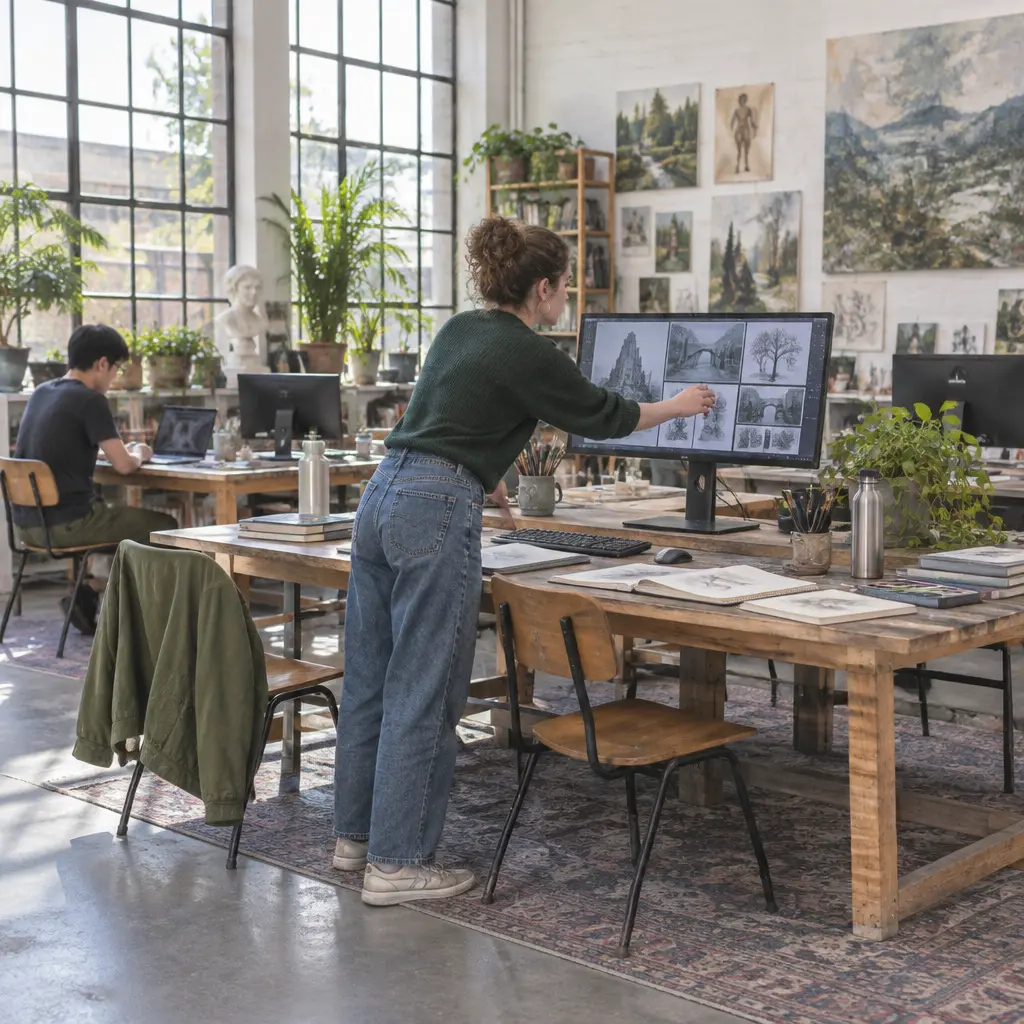
How AI Is Reshaping Creative Communities
Artificial intelligence is reshaping creative communities: the networks of artists, writers, designers, musicians, and audiences who make, share, and discuss cultural work. Generative AI tools can speed up drafting and production, widen access to creative software, and enable new forms of collaboration, while raising disputes about consent, credit, compensation, and the value of human-made work. The change is already measurable: in a 2024 global survey, 83% of respondents working in the creative industries said they had used generative AI in their work. Understanding its impact means looking not only at creative practice, but also at community participation, labor and livelihoods, and the governance choices that will shape what comes next.
AI adoption in creative communities
Artificial intelligence (AI) refers broadly to computer systems that perform tasks associated with human intelligence. Generative AI is a subset that produces new text, images, audio, video, or other content in response to prompts or other inputs. The International Labour Organization describes generative AI as technology that can generate content, including text, images, and other media, and has analyzed how it may transform tasks across occupations.
Creative communities include professional and amateur makers, cultural organizations, online platforms, educators, and audiences. AI enters these communities through several routes: as a production tool, a learning aid, a collaborative partner, a distribution mechanism, and a subject of debate. A 2024 survey by the Society of Authors found that 83% of its respondents in the creative industries had used generative AI, although the survey’s respondents should not be treated as a representative measure of every creator worldwide.
AI as a tool for creative production
In production, AI tools assist with tasks such as brainstorming, editing, image generation, sound cleanup, translation, and prototyping. Their value depends on the task and the creator’s aims: a writer may use a language model to organize research, while an illustrator may use image software to explore compositions. In the Society of Authors’ 2024 survey, 31% of respondents said they had used generative AI in their professional work, illustrating that experimentation and routine professional adoption are not the same thing.
The technology can reduce the time or technical knowledge required for some early-stage tasks. It does not, by itself, establish artistic intent, factual accuracy, originality, or audience fit. Human review remains important, particularly when generated material could reproduce errors, stereotypes, or recognizable elements of existing work.
AI as an access and learning aid
AI can lower some barriers to making and sharing work. Text-to-image systems, speech tools, automated captions, translation, and adaptive interfaces may help people explore creative ideas or participate in settings that previously required specialized equipment or technical skills. These tools can be useful to disabled creators and people working across languages, though their accessibility and quality vary.
Access is not automatic or universal. The International Telecommunication Union estimated that 2.6 billion people remained offline in 2023, a reminder that participation in digital creativity still depends on connectivity, devices, and skills. Models can also perform unevenly across languages and cultures, so expanding access requires attention to who is represented in training data and who can afford the tools.
Because individual uses scale through platforms and networks, AI’s effects extend beyond the studio or desk: they can alter who gets seen, how communities collaborate, and how creative work circulates.
AI and collaboration in creative communities
Creative collaboration is the process through which people contribute ideas, skills, feedback, and resources to make or interpret work together. AI adds a nonhuman system to this process, but it does not become a community member in the human sense: it has no lived experience, independent accountability, or personal stake in the outcome. Its role is shaped by the people who design, select, prompt, edit, and share its output.
Human–AI co-creation
Co-creation describes a workflow in which people and AI systems iteratively influence an outcome. A musician might generate variations and then arrange and perform selected parts; a game designer might use AI to draft dialogue before revising it for character and continuity. In these examples, the system supplies possibilities, while human participants decide what to accept, change, reject, and publish.
The label “co-creation” can obscure differences in contribution. A transparent account of process can distinguish generated material from human direction, editing, performance, and final selection. This helps collaborators and audiences understand how a work was made and where responsibility lies.
Online communities, remix, and participation
Online creative communities form around shared interests, platforms, genres, and practices such as fan art, remix, open-source software, and collaborative storytelling. AI can make it faster to create variations, translate contributions, or produce prototypes that invite feedback. At the same time, high volumes of generated content can make it harder for audiences to find work, for moderators to assess submissions, and for creators to establish attribution.
Platform rules therefore matter. Policies about labeling, synthetic media, training-data consent, and moderation help determine whether AI expands meaningful participation or simply increases the quantity of content. Communities can supplement platform rules with shared norms, such as disclosing AI assistance and obtaining permission before imitating a living artist’s identifiable style.
Cultural diversity and representation
Creative AI reflects choices about training data, model design, and evaluation. If datasets overrepresent dominant languages or commercially visible cultural forms, generated results may reproduce those priorities and render other traditions less visible. UNESCO’s 2021 Recommendation on the Ethics of Artificial Intelligence calls for attention to cultural diversity and the effects of AI on cultural expression.
Community participation in dataset decisions, evaluation, and product design can help surface these risks. However, representation alone does not settle questions of permission or benefit: including cultural material in a dataset does not necessarily mean its creators or communities agreed to its use.
These collaborative opportunities are closely tied to economic conditions. Whether creators can benefit from new tools depends partly on the effects on paid work, bargaining power, and the distribution of income.
AI, creative labor, and livelihoods
Creative labor includes the paid and unpaid work involved in producing, editing, performing, distributing, and supporting cultural goods. AI may automate parts of a job without eliminating the occupation as a whole; it may also change rates, workloads, and expectations. The International Labour Organization’s 2023 analysis of generative AI and jobs concluded that transformation of work is more likely than full automation for many occupations, while emphasizing that effects differ by task and worker group.
Changing tasks and employment conditions
Routine or repeatable tasks—such as producing initial drafts, resizing images, or creating basic variations—may be especially exposed to automation. Other activities, including client communication, performance, contextual judgment, and original direction, may remain dependent on human expertise, although workflows can change around them. Potential benefits include faster turnaround and new services; potential costs include reduced demand for some assignments, lower fees, or pressure to produce more work in less time.
The ILO’s 2023 study estimated that 5.5% of employment in high-income countries was potentially exposed to the automation effects of generative AI, compared with 0.4% in low-income countries. These figures cover employment broadly, not creative workers alone, and describe exposure rather than certain job losses. They underscore the importance of distinguishing what a tool can technically do from how employers and platforms choose to use it.
Copyright, consent, and attribution
Copyright rules differ across jurisdictions, but disputes around generative AI commonly concern the use of protected works in training, the legal status of generated output, and the attribution of human contributions. The U.S. Copyright Office’s 2025 report on copyrightability states that copyright protection in the United States requires human authorship; AI assistance does not automatically disqualify a work, but protection depends on the human contribution and the circumstances.
Training-data questions are distinct from questions about whether a particular output is copyrightable. Creators and organizations should review applicable law, contracts, and platform terms rather than assume that generated content is free of rights concerns. Clear disclosure, permission practices, and records of human editing can reduce confusion, though they do not resolve every legal dispute.
Compensation and bargaining power
Compensation concerns arise when creative work contributes to AI systems or when AI-generated substitutes affect the market for human-made work. In its 2024 survey, the Society of Authors reported that 26% of respondents said they had lost work because of generative AI, and 37% said their income had decreased because of it. These are self-reported findings from the survey’s respondents, not a census of the creative workforce, but they document significant concern among participating authors and creative professionals.
Possible responses include collective bargaining, licensing arrangements, opt-in or opt-out mechanisms where legally available, provenance standards, and procurement policies that specify permitted uses. The effectiveness of these approaches depends on enforceability and the ability of individual creators to negotiate with larger organizations.
Economic outcomes are not determined by technology alone. They also reflect the rules communities, companies, and governments establish for transparency, safety, and accountability.
Governance and responsible use of AI in creative communities
AI governance is the set of laws, standards, policies, and community practices that guide the development and use of AI. For creative communities, it can cover data sourcing, consent, disclosure, credit, safety, moderation, accessibility, and redress. Effective governance should be specific enough to guide practice while flexible enough to accommodate different art forms, cultural contexts, and levels of risk.
Transparency and provenance
Transparency means making relevant information about an AI system or its use available to affected people. Provenance refers to information about a piece of content’s origin and history, including how it was created or altered. Labels and production records can help audiences distinguish documentary material from synthetic content and help collaborators understand what they are reviewing.
Disclosure need not be identical for every case. A private brainstorming aid may warrant a different level of disclosure than a synthetic image presented as a documentary photograph. The key questions are whether the use could materially affect trust, consent, credit, or safety, and whether the audience has a reasonable need to know.
Risk assessment and community standards
Risk assessment identifies possible harms before or during deployment and considers who may be affected. The National Institute of Standards and Technology’s AI Risk Management Framework organizes this work around four functions: Govern, Map, Measure, and Manage. Creative organizations can adapt this approach by examining dataset provenance, testing for biased outputs, setting limits on impersonation, and providing a clear process for reporting harm.
Community standards can make these principles practical. For example, a publisher might require disclosure of substantial AI-generated text; an arts organization might prohibit unauthorized voice or likeness replication; a platform might provide provenance labels and appeal processes. Standards are more credible when creators, audiences, and affected communities help design them and when enforcement is consistent.
Education and creative agency
AI literacy is the ability to understand how AI systems work, what their limits are, and how to use or challenge them responsibly. For creators, it includes evaluating outputs, protecting confidential work, checking factual claims, understanding licensing terms, and recognizing when a tool may be reproducing harmful or misleading material.
Education should preserve creative agency rather than present AI adoption as inevitable. Training can help people choose when a tool supports their aims and when a human-only process, a different technology, or no automation is preferable. Arts schools, unions, libraries, and community organizations can support this work by sharing practical guidance and creating spaces to discuss emerging practices.
Conclusion: shaping AI around creative communities
AI is changing creative production by assisting with tasks, widening some forms of access, and enabling new human–AI workflows. It is also reshaping online collaboration, cultural representation, employment conditions, and debates over consent, credit, and compensation. Survey evidence indicates that generative AI is already being used by many creative professionals, while the ILO’s research cautions that its workplace effects are varied and are more often expected to transform tasks than simply eliminate whole occupations.
The broader implication is that creative communities should not treat AI as only a software question. Its effects depend on governance, platform choices, labor protections, cultural participation, and the ability of creators to shape the systems that affect their work. Creators and organizations can begin by documenting AI use, reviewing rights and contracts, developing community standards, and ensuring that affected people have a voice in decisions. Further reading from the International Labour Organization, UNESCO, the U.S. Copyright Office, and the National Institute of Standards and Technology can help communities make those choices with better evidence.
Sources: International Labour Organization, Generative AI and Jobs: A Global Analysis of Potential Effects on Job Quantity and Quality, 2023, https://www.ilo.org/publications/generative-ai-and-jobs-global-analysis-potential-effects-job-quantity-and; Society of Authors, Survey Reveals: 26% of Authors Already Losing Income Due to AI, 2024, https://societyofauthors.org/2024/04/17/survey-reveals-26-of-authors-already-losing-income-due-to-ai/; International Telecommunication Union, Facts and Figures 2023, https://www.itu.int/itu-d/reports/statistics/facts-figures-2023/; UNESCO, Recommendation on the Ethics of Artificial Intelligence, 2021, https://www.unesco.org/en/legal-affairs/recommendation-ethics-artificial-intelligence; U.S. Copyright Office, Copyright and Artificial Intelligence, Part 2: Copyrightability, 2025, https://www.copyright.gov/ai/; National Institute of Standards and Technology, AI Risk Management Framework, 2023, https://www.nist.gov/itl/ai-risk-management-framework.