
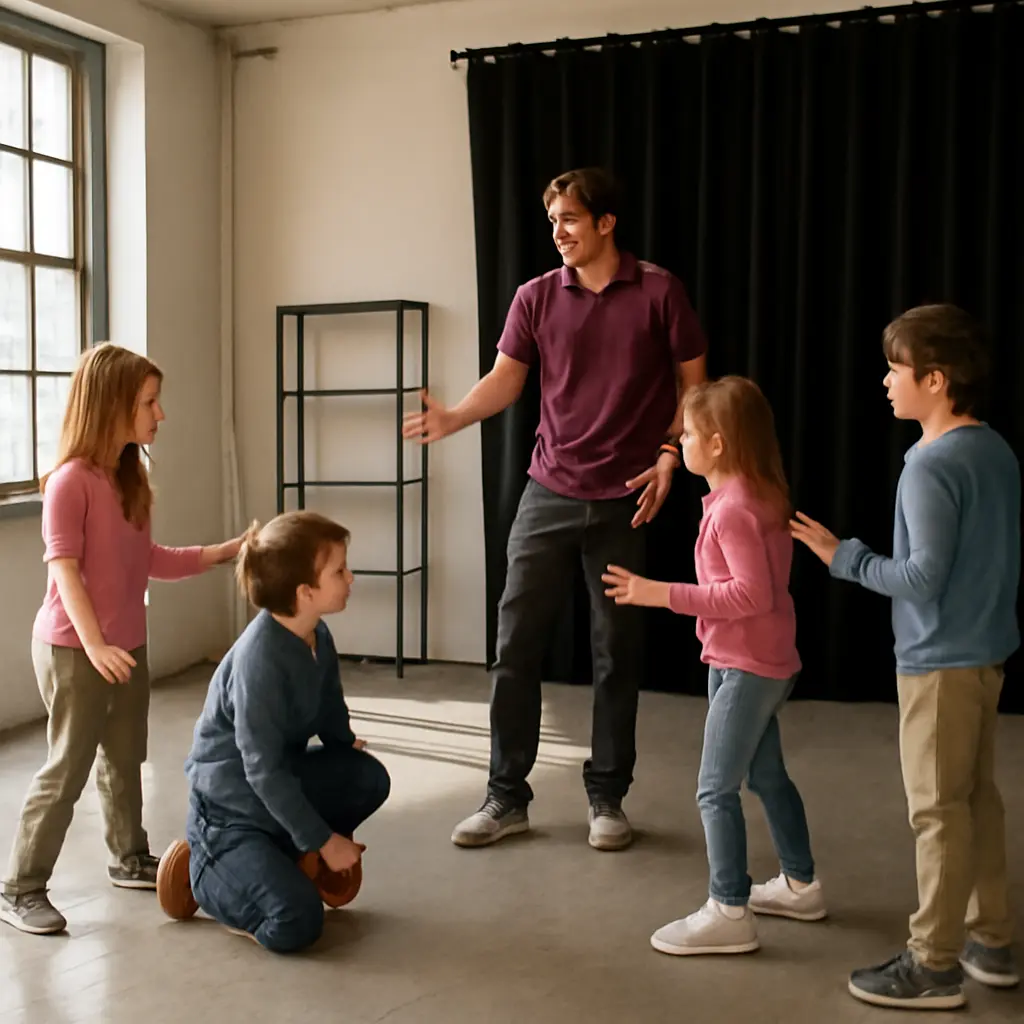
Theater programs that actually teach kids emotional intelligence, not just lines
Theater programs that build emotional intelligence teach children to recognize feelings, understand other people’s perspectives, and choose thoughtful responses—not merely memorize lines. Research on arts education and social-emotional learning suggests that drama’s combination of role-play, collaboration, and reflection can support empathy and social skills, although results depend on program design and should not be treated as a guaranteed clinical outcome. The most promising programs pair performance with explicit emotional learning, inclusive teaching, and feedback, giving families practical ways to distinguish meaningful development from rehearsal alone.
How Theater Programs Develop Emotional Intelligence
Emotional intelligence is commonly understood as the capacity to recognize and manage emotions in oneself and to perceive and respond constructively to emotions in others. In an educational setting, the Collaborative for Academic, Social, and Emotional Learning (CASEL) describes social-emotional learning through five related competencies: self-awareness, self-management, social awareness, relationship skills, and responsible decision-making. Theater can give children a structured place to practice these skills through characters, scenes, group choices, and reflection.
That distinction matters because taking part in a play is not automatically the same as learning emotional skills. A production can teach timing, memorization, and stagecraft without helping children name feelings or consider another person’s point of view. Programs make the connection clearer when instructors deliberately ask what characters feel, what evidence supports that interpretation, and how a scene might change if a character chose a different response.
Character work and perspective-taking
Perspective-taking means considering how a situation may look and feel from someone else’s position. When children explore a character’s goals, fears, and relationships, they practice interpreting behavior in context rather than relying only on first impressions. This is a useful classroom exercise, but pretending to feel what a character feels should not be presented as proof that a child has developed empathy in everyday life.
A strong instructor connects character questions to observable details: “What did the character say or do?” and “What else might explain it?” Children can then test different interpretations through improvisation. This approach supports curiosity and discourages the simplistic lesson that one character is always “good” and another is always “bad.”
Ensemble work and relationship skills
An ensemble is a group that makes a performance together, with members depending on one another to rehearse, share space, and keep scenes moving. Children can practice listening, turn-taking, respectful disagreement, and repair after mistakes. A director who distributes meaningful roles and invites children to contribute ideas can make collaboration part of the learning, rather than treating it as a side effect of putting on a show.
The quality of the group climate matters. If children are mocked for mistakes, excluded from decisions, or pressured into roles that make them uncomfortable, rehearsal may undermine the very skills the program hopes to foster. Families can ask how staff address conflict, bullying, and unequal participation.
Which Theater Activities Teach Emotional Skills
Theater-based emotional learning includes several related approaches, from improvisation to scripted productions. Their shared value is that they turn abstract ideas—such as managing frustration or noticing another person’s needs—into situations children can explore safely. The activity alone is not the curriculum: facilitator prompts, reflection, and inclusive participation help connect acting to daily life.
Improvisation and emotional vocabulary
Improvisation is unscripted scene-making in which participants respond to a situation as it develops. A facilitator might invite children to play the same disagreement with different emotions, then discuss how facial expression, tone, and body language changed the scene. Children can learn to distinguish, for example, disappointment from anger or nervousness from excitement, while recognizing that outward cues do not reveal someone’s feelings with certainty.
A well-designed exercise includes a pause for reflection and choices about how to proceed. Instructors should avoid asking children to disclose private experiences or perform distressing scenarios. Fictional situations provide room to explore difficult feelings without requiring personal revelation.
Role-play, conflict, and decision-making
Role-play lets children try out ways to handle a conflict, such as asking for space, explaining a concern, or seeking help from a trusted adult. The instructor can stop a scene, invite the group to suggest alternatives, and replay the moment. This “rehearse, reflect, retry” pattern makes responsible decision-making visible and helps children compare likely consequences without implying that every real-life conflict has one easy solution.
Programs should distinguish ordinary peer disagreements from situations involving intimidation, harassment, or safety risks. Children need to know that performing a conflict scene is not a substitute for adult intervention when someone is being harmed.
Scripted productions and reflection
A scripted production can support emotional learning when rehearsal includes discussion of character motivation, relationships, and consequences. After a scene, children might identify what a character wanted, what obstacle arose, and how the character’s response affected others. Without that instructional layer, a production can still be valuable for artistic development, but claims that it teaches emotional intelligence should be more cautious.
Reflection can be brief and age-appropriate: a check-in before rehearsal, a question after a scene, or a group conversation about how collaborators handled a disagreement. Educators should make participation flexible, since some children express understanding more comfortably through drawing, writing, or observation than speaking in front of the group.
What the Evidence Says About Drama and Social-Emotional Learning
Research supports drama as a promising learning context, but the evidence does not justify claiming that every theater class improves emotional intelligence. Studies vary in program length, age group, teaching methods, and outcomes measured. Families and schools should look for evidence that matches the specific claim being made, and distinguish short-term classroom observations from lasting changes in children’s behavior.
Research findings and their limits
A 2015 meta-analysis by the University of Sydney’s Brian Goldstein and his colleagues examined drama-based instruction and found positive effects across several learning outcomes, including social and emotional measures. The authors also noted variation among studies and the importance of how drama was implemented. A meta-analysis summarizes results from multiple studies, but its findings do not establish that all programs—or all children—will experience the same benefits.
The National Endowment for the Arts has also reviewed research on arts education and outcomes such as social-emotional development. Such reviews are useful context, but broad arts-education evidence may include different art forms and program designs. It should not be read as a direct evaluation of every children’s theater organization.
For a useful program evaluation, ask what skills are taught, how progress is assessed, and whether the measures reflect real behavior rather than confidence on stage alone. Relevant indicators might include children’s ability to name emotions, listen without interrupting, explain another character’s viewpoint, or use a practiced strategy during group work.
A practical program example: process drama
Process drama is an educational approach in which a group builds and explores a fictional situation without necessarily preparing a public performance. A teacher may set a shared problem—a community facing a difficult choice, for example—and invite children to enter different roles, question one another, and examine possible outcomes. Because the emphasis is on exploration rather than a polished show, the approach can create more time for discussion and revision.
This example illustrates a program feature rather than a claim that one named intervention works for every child. Its value depends on skilled facilitation, emotionally safe boundaries, and opportunities for children to step out of role and reflect. Programs should also adapt activities for children with disabilities, language differences, sensory needs, or different comfort levels with performance.
How to Choose a Theater Program That Builds Emotional Intelligence
Families can assess a program by looking beyond its show calendar. A theater program that intentionally teaches emotional skills should be able to explain what children will practice, how instructors guide reflection, and how the program handles inclusion and conflict. The following questions help turn a broad promise into observable teaching practices.
- Does the program name specific goals, such as emotional vocabulary, perspective-taking, self-regulation, or collaborative problem-solving?
- Do instructors ask children to reflect on characters’ feelings and choices, rather than focus exclusively on memorization and performance?
- How are disagreements, teasing, and unequal participation addressed?
- Can children choose an alternative to performing a scene or sharing personal experiences?
- Are activities accessible to children with different communication, mobility, sensory, and learning needs?
- How does the program assess progress, and does it avoid promising guaranteed therapeutic or clinical results?
Look for trained, reflective instructors
Instructors need both theater skills and the ability to manage a supportive learning environment. Ask whether staff have experience working with children, receive training in safeguarding and inclusion, and know when to refer a concern to a parent, school professional, or qualified clinician. A theater program can support social-emotional learning, but it is not a substitute for mental-health care.
Check the balance between process and performance
A final show can motivate children and celebrate their work, but rehearsals should leave room for experimentation, mistakes, and discussion. If emotional learning is a stated goal, ask how much class time is devoted to group reflection and skill practice. Programs should be transparent about whether their primary purpose is performance training, social development, or both.
Conclusion: Theater Can Make Emotional Skills Rehearsable
Theater programs can support emotional intelligence when they combine character perspective-taking, ensemble relationships, improvisation, conflict practice, and structured reflection. Research reviewed by scholars and arts-education organizations makes drama a credible approach to explore, while also reminding families that outcomes depend on program quality and cannot be assumed from participation alone.
For parents and educators, the practical next step is to ask programs how they teach and assess specific skills—not just whether children will perform. Choose settings that protect emotional safety, welcome different ways of participating, and give children repeated chances to reflect and try again. Further reading from CASEL, the National Endowment for the Arts, and research on drama-based instruction can help families evaluate claims with care.
Sources: Collaborative for Academic, Social, and Emotional Learning (CASEL), What Is the CASEL Framework?, https://casel.org/fundamentals-of-sel/what-is-the-casel-framework/; Goldstein, T. R., and Winner, E., “Enhancing Empathy and Theory of Mind,” Journal of Cognition and Development, 2012, https://doi.org/10.1080/15248372.2011.573514; Lee, B. K., Patall, E. A., Cawthon, S. W., and Steingut, R. R., “The Effect of Drama-Based Pedagogy on PreK–16 Outcomes: A Meta-Analysis of Research From 1985 to 2012,” Review of Educational Research, 2015, https://doi.org/10.3102/0034654314540477; National Endowment for the Arts, The Arts and Human Development: Framing a National Research Agenda for the Arts, Lifelong Learning, and Individual Well-Being, 2011, https://www.arts.gov/sites/default/files/TheArtsAndHumanDev.pdf.