
Artists from all backgrounds reshape what public culture looks like
Public culture is the shared collection of images, stories, performances, and spaces through which communities represent themselves. Artists from different racial, cultural, economic, geographic, and disability backgrounds reshape it by bringing overlooked histories into view, challenging inherited assumptions, and expanding who gets to create and encounter art. Their impact is visible in museum collections, public commissions, film, music, and community-led projects—but representation alone does not guarantee influence: access to funding, decision-making, and audiences matters too. Data from U.S. arts institutions and international cultural organizations underscores both the value of inclusive participation and the continuing disparities that artists and communities confront.
Artists’ backgrounds reshape public culture through representation
In this article, “artists’ backgrounds” refers to the lived experiences and social identities that inform an artist’s perspective, practice, and relationship to audiences. UNESCO’s 2005 Convention on the Protection and Promotion of the Diversity of Cultural Expressions recognizes that cultural expressions are conveyed through diverse creative activity and that cultural diversity is strengthened when people can create, produce, and share those expressions. This framework helps explain why inclusion involves more than displaying a wider range of work: it also concerns who has the resources and authority to make cultural decisions.
The scale of the cultural economy makes the stakes substantial. UNESCO’s 2022 report, Re|Shaping Policies for Creativity, estimates that cultural and creative industries generate 3.1% of global gross domestic product and account for 6.2% of employment worldwide. Those figures describe economic activity, not the distribution of its benefits. Examining representation, participation, and institutional power together provides a fuller picture of how artists change public culture.
Representation and the visibility of lived experience
Representation is the presence and portrayal of people, communities, and histories in cultural work. Artists who draw on experiences that have been excluded or simplified in mainstream media can complicate familiar narratives and create room for audiences to recognize different realities. This includes, among other forms, Indigenous art, diasporic storytelling, queer performance, disability arts, and work shaped by working-class or rural experience. These categories overlap; they are not fixed or interchangeable identities.
The Smithsonian American Art Museum’s exhibition ¡Printing the Revolution! The Rise and Impact of Chicano Graphics, 1965 to Now demonstrates how art can make cultural and political histories publicly legible. It brought together posters, prints, and other works connected to Chicano activism and community life, linking historical movement art with contemporary practice. The example shows that representation is not simply a matter of adding individual artists to a collection: the selection, interpretation, and historical context of work also shape what audiences understand.
Authorship, access, and decision-making
Cultural participation means having practical opportunities to create, present, and circulate work—not just being represented as a subject. Those opportunities depend on factors such as paid time, training, accessible venues, commissions, networks, and control over how work is presented. The National Endowment for the Arts’ 2022 report, Artists and Other Cultural Workers: A Statistical Portrait, uses U.S. labor data to describe artists as workers and documents the range of occupations and employment conditions involved. Its perspective is a reminder that cultural visibility sits alongside material questions about jobs, income, and working conditions.
The distinction matters because an institution can exhibit diverse work while leaving its selection and funding practices unchanged. Equitable participation therefore asks who commissions the work, who receives payment, who controls interpretation, and whether artists can build sustainable careers. These questions connect representation to the institutional structures that determine which cultural expressions reach broad audiences.
Artists’ backgrounds reshape public culture through institutions and public space
Museums, galleries, festivals, libraries, and public agencies act as cultural gatekeepers: they preserve work, allocate resources, and decide what receives public attention. Their choices can widen the recognized cultural record, but they can also reproduce longstanding exclusions. Artists’ influence becomes more durable when institutions change not only what they show, but how they collect, commission, interpret, and share authority.
Collections and curatorial change
Curatorial practice is the process of selecting, organizing, interpreting, and caring for cultural work. Broadening collections can correct gaps in the record, while transparent interpretation can explain how those gaps developed. The Smithsonian’s National Museum of African American History and Culture, which opened to the public in 2016, offers a major example of an institution dedicated to presenting African American history and culture within the national story. Its existence does not resolve every question of representation, but it makes clear that institutional space and public resources help determine which histories are available to audiences.
Useful measures include the diversity of artists represented, the share of acquisitions and commissions directed to underrepresented creators, the accessibility of exhibitions, and whether communities participate in interpretation. These measures need context: a single percentage cannot capture the complexity of artistic practice, and demographic categories should not be treated as substitutes for artists’ individual identities or achievements.
Public art and community-led practice
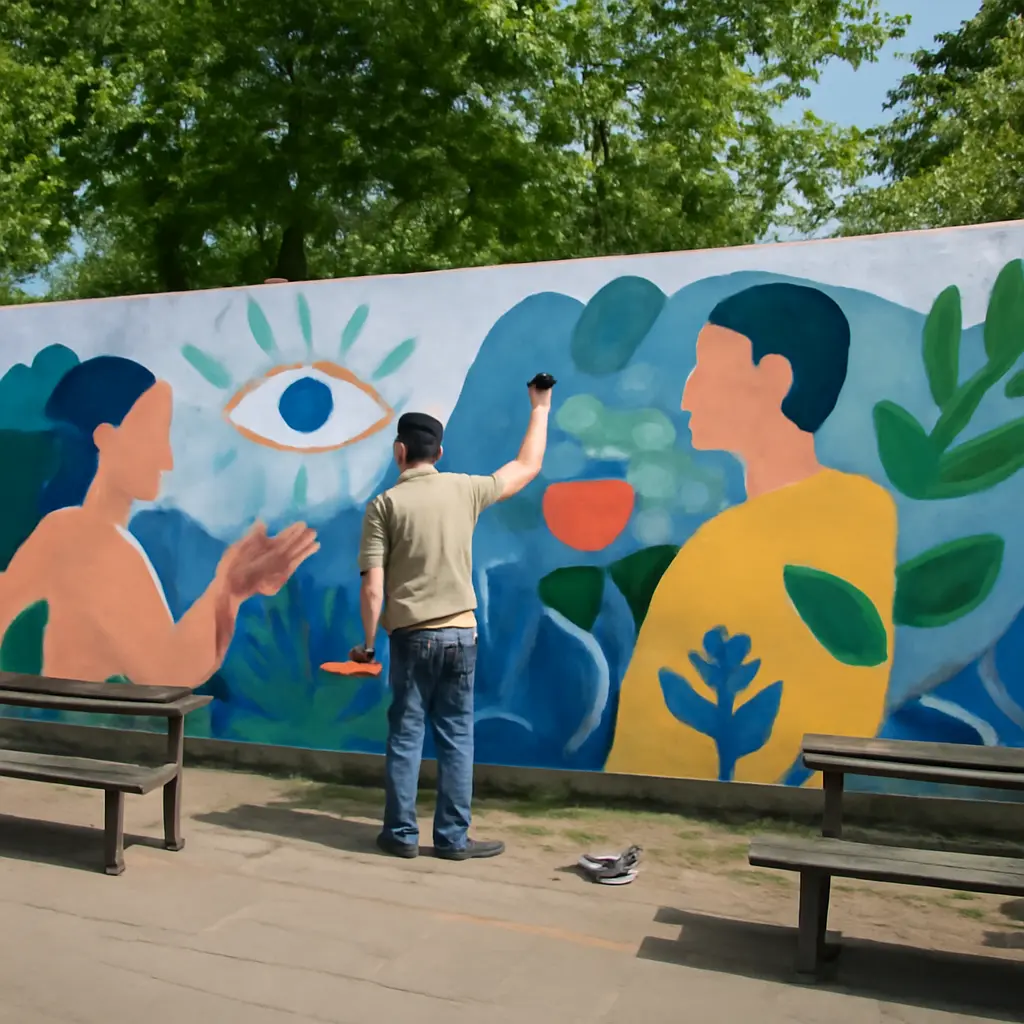
Public art is art made for or placed in shared environments, including streets, transit systems, parks, and civic buildings. Because it encounters people beyond traditional arts venues, it can make local memory and debate part of everyday life. Community-led projects may involve residents in choosing themes, selecting artists, or shaping the final work; this participation can help ensure that public art reflects the people who live with it.
The National Endowment for the Arts’ Our Town program supports creative placemaking, a practice that integrates arts, culture, and design into community development. Such efforts can support local identity and collaboration, but their value depends on meaningful involvement rather than using art as a decorative substitute for addressing community needs. Evaluation should therefore consider who set the project’s goals, who was paid, whose stories were included, and how residents assessed the result.
Artists’ backgrounds reshape public culture across media and audiences
Cultural influence travels through more than museums and public commissions. Film, television, music, publishing, digital platforms, and live performance each shape the stories that circulate and the audiences who encounter them. Different media offer distinct opportunities: a community mural anchors meaning in a place, while a widely distributed film or song can carry cultural references across borders.
Film, television, music, and publishing
In screen media, representation depends on both on-screen roles and the people who write, direct, produce, and distribute them. UCLA’s 2024 Hollywood Diversity Report examines representation in film and television and tracks disparities across creative roles and industry employment. Its analysis reinforces a key point: visibility in front of the camera does not necessarily mean equal access to the jobs and decisions behind it.
The same distinction applies to music and publishing. Artists can introduce languages, sounds, and perspectives that change mainstream expectations, while publishers and platforms determine how easily audiences can find that work. A meaningful assessment therefore looks beyond celebrated examples to patterns in commissioning, credit, distribution, compensation, and creative control.
Digital circulation and cultural exchange
Digital platforms can lower some barriers to publication and help artists connect with audiences across borders. UNESCO’s 2022 creativity policy report identifies the digital environment as a significant factor in the circulation of cultural goods and services, while also highlighting uneven benefits and challenges for creators. Online access does not automatically create equitable reach: platform algorithms, monetization rules, copyright practices, language barriers, and unequal access to technology all influence whose work is seen and paid for.
Digital exchange also raises questions about cultural context and ownership. Artists and communities may seek attribution, consent, and control when cultural knowledge or imagery circulates beyond its original setting. Supporting diverse public culture therefore requires both wider distribution and respect for the people and traditions from which creative work emerges.
Conclusion: Artists’ backgrounds reshape public culture through access and shared authority
Artists from varied backgrounds reshape public culture by making more experiences visible, widening participation, challenging institutional habits, and carrying new perspectives across public spaces and media. The evidence points to a cultural sector with considerable economic and social reach, but access to resources and decision-making remains central to whether that reach is shared fairly. Representation, institutional practice, community involvement, and digital circulation are connected: progress in one area is more durable when the others develop too.
Readers can support this work by attending local exhibitions and performances, following artists directly, advocating for accessible and fairly paid commissions, and asking cultural organizations how they select, fund, and interpret work. For further study, explore UNESCO’s creativity policy research, the National Endowment for the Arts’ reports on artists and creative placemaking, and UCLA’s analysis of representation in entertainment.
Sources: UNESCO, Convention on the Protection and Promotion of the Diversity of Cultural Expressions, 2005, https://unesdoc.unesco.org/ark:/48223/pf0000142919; UNESCO, Re|Shaping Policies for Creativity: Addressing Culture as a Global Public Good, 2022, https://unesdoc.unesco.org/ark:/48223/pf0000380474; National Endowment for the Arts, Artists and Other Cultural Workers: A Statistical Portrait, 2022, https://www.arts.gov/impact/research/publications/artists-and-other-cultural-workers-statistical-portrait; Smithsonian American Art Museum, ¡Printing the Revolution! The Rise and Impact of Chicano Graphics, 1965 to Now, https://americanart.si.edu/exhibitions/printing-revolution; Smithsonian National Museum of African American History and Culture, About the Museum, https://nmaahc.si.edu/about; National Endowment for the Arts, Our Town, https://www.arts.gov/initiatives/creative-placemaking/our-town; UCLA College, Social Sciences, Hollywood Diversity Report, 2024, https://socialsciences.ucla.edu/hollywood-diversity-report/.