
Why Are the Arts Important for Children’s Development?
The arts—visual art, music, dance, drama, and creative writing—are ways children explore ideas and express what they know, feel, and imagine. Arts education combines making, performing, and responding to creative work. It matters because it can support children’s communication, motor skills, social and emotional growth, and engagement with learning, while giving them meaningful opportunities to create and collaborate. Evidence is strongest for specific outcomes and particular programs, not for a claim that every arts activity automatically raises achievement across all subjects. The National Endowment for the Arts’ review of research and a randomized evaluation of Chicago arts integration programs offer useful context for understanding both the promise and limits of the evidence.
Arts Education Supports Children’s Development Through Multiple Pathways
Arts education is structured learning in one or more art forms, including visual arts, music, dance, theater, and creative writing. The National Core Arts Standards describe learning through creating, performing or presenting, and responding to or connecting with art. This definition highlights that arts education is not simply keeping children occupied: it involves developing skills, making choices, interpreting meaning, and sharing work.
The arts can contribute to development through distinct but overlapping pathways. Drawing and sculpting invite children to plan and refine; music and movement exercise listening, rhythm, and coordination; drama gives children practice with language, perspective-taking, and cooperation. These experiences can complement academic learning, but their value is also intrinsic: children deserve access to artistic expression and cultural participation.
Cognitive and Academic Development
Cognitive development includes skills such as attention, memory, reasoning, and problem-solving. Creating art often asks children to make a plan, test materials or ideas, notice what is working, and revise. A child composing a short rhythm, for example, must listen, remember a sequence, and decide how to change it; a child designing a model must consider form, materials, and purpose.
Research suggests that arts learning may support some academic outcomes, especially when instruction is thoughtfully connected to subject matter. In a randomized study of the Chicago Arts Partnerships in Education program, researchers at the University of Chicago Consortium on School Research reported that students in participating schools showed improvements in writing and reduced disciplinary incidents compared with students in the study’s comparison schools. The findings are evidence about that particular program and setting—not proof that all arts activities produce the same results or that arts participation alone raises achievement in every subject.
Language, Communication, and Literacy
Arts activities offer children varied ways to communicate, including speech, movement, sound, images, and written words. In drama, children may retell a story from a character’s point of view; in visual art, they can explain the choices behind an image. These activities encourage description, sequencing, interpretation, and listening—skills that also matter in classroom discussion and literacy learning.
The National Endowment for the Arts’ research reviews have examined connections between arts participation and outcomes such as literacy, academic engagement, and social development. Such associations depend on factors including the type and quality of instruction, students’ circumstances, and how outcomes are measured. Arts experiences are best treated as a rich complement to language learning, not a replacement for explicit reading and writing instruction.
Motor Skills, Sensory Learning, and Coordination
Motor development is the growth of children’s ability to control and coordinate movement. Painting, cutting, building, playing instruments, and dancing offer different forms of practice: some call for precise hand movements, while others involve balance, timing, spatial awareness, and whole-body coordination. Children also learn through sensory exploration as they compare textures, shapes, sounds, and movements.
These activities should be adapted to children’s ages, abilities, and access needs. Large brushes, tactile materials, visual rhythm cues, or seated movement options can make participation more inclusive. The developmental purpose is not to demand polished performance, but to give children safe opportunities to explore, practice, and make choices.
Arts Education Builds Social and Emotional Capabilities
Social and emotional development involves recognizing and expressing feelings, managing responses, building relationships, and working with others. The arts can provide a concrete setting for these skills because children make personal choices while also responding to peers, shared tasks, and creative expectations. The experience varies by activity and classroom climate: supportive teaching matters more than the art form alone.
Emotional Expression and Well-Being
Making or responding to art can give children a way to explore experiences and communicate feelings that may be difficult to put into words. A drawing, movement sequence, or invented story can help a child represent an idea and then discuss it with a trusted adult. This can support reflection and connection, though arts activities should not be presented as a substitute for mental-health care when a child needs professional support.
The World Health Organization’s 2019 scoping review examined evidence on arts and health across the lifespan, including children and young people. It described multiple ways arts engagement may contribute to health and well-being, while emphasizing that the evidence spans many activities and study designs. This broad review supports taking arts participation seriously as part of a healthy, enriching environment without treating every creative activity as a clinical intervention.
Collaboration, Empathy, and Belonging
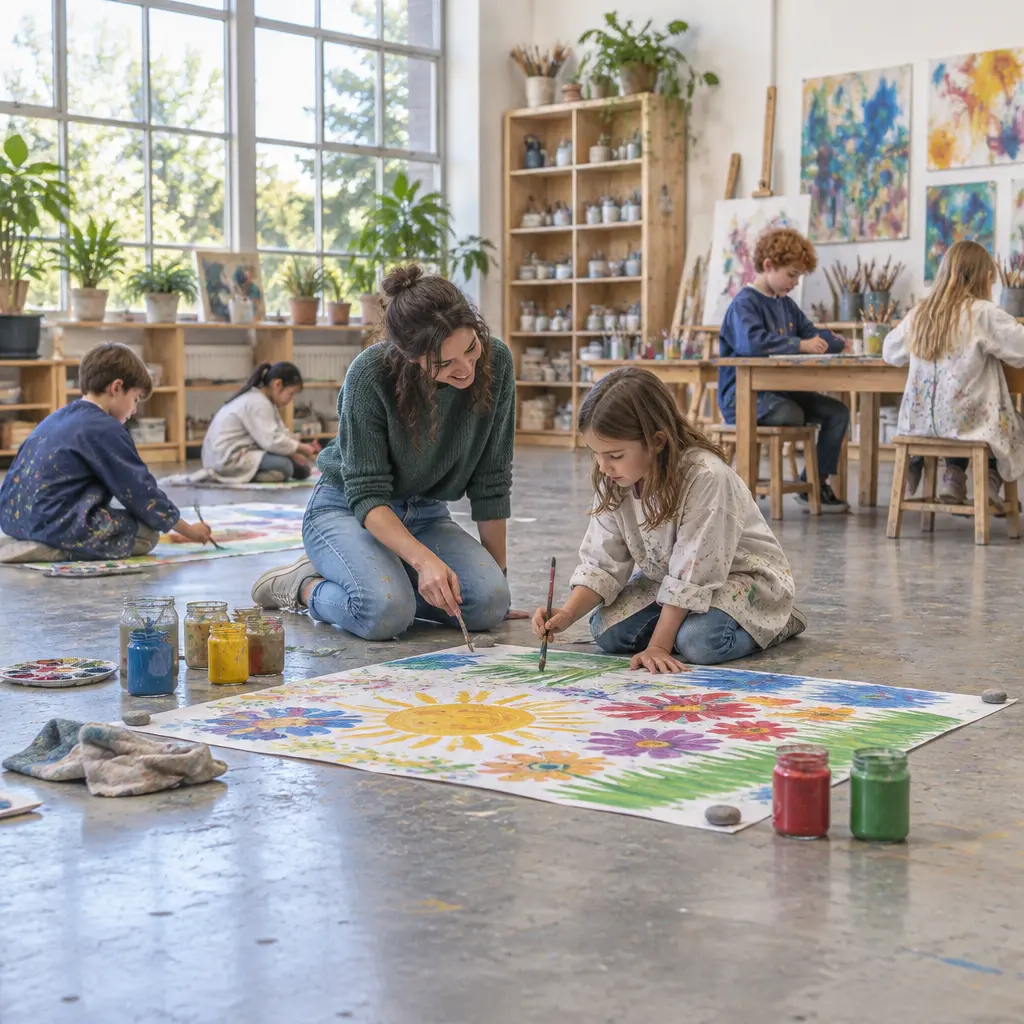
Group performances, murals, ensembles, and shared storytelling teach children to coordinate contributions and attend to others. A child in a theater group may need to listen for a cue; a group making a mural must negotiate space, color, and design. Taking on different roles or interpreting a story from another character’s perspective can also create opportunities to practice empathy.
The U.S. National Core Arts Standards include creating, presenting, responding, and connecting as central processes. These processes help explain why arts learning can involve both individual voice and shared responsibility. A welcoming environment is essential: children need respectful feedback, room to experiment, and assurance that participation is valued even when skill levels differ.
Creative Practice Encourages Agency and Lifelong Learning
Creative development is the ability to generate, explore, and refine ideas. In arts learning, children encounter choices with more than one possible answer: which materials to use, how to interpret a song, or how to tell a story. This open-ended work can encourage curiosity and persistence, especially when adults focus on exploration and revision rather than comparing children’s products.
Imagination, Experimentation, and Problem-Solving
Arts activities make experimentation visible. Children might discover that changing the pressure of a pencil changes a line, that a rhythm sounds different at another tempo, or that a structure needs a wider base. They can test ideas, respond to unexpected results, and decide whether to revise or begin again. These habits resemble problem-solving in other areas, though transfer from arts learning to unrelated academic tasks is not automatic.
The National Endowment for the Arts has reviewed research on arts education and learning, noting that outcomes differ across art forms, age groups, and program designs. That variation is important: a well-supported, sustained program with skilled instruction is not equivalent to an occasional craft activity. Educators and families can use the evidence responsibly by asking what children are learning, how instruction is delivered, and how outcomes are assessed.
Cultural Identity and Appreciation
Arts learning helps children encounter the stories, practices, and creative traditions of their own communities and others. Listening to music from different cultures, studying local artists, or creating work inspired by family histories can affirm identity and broaden understanding. Good teaching presents cultural material with context and respect, avoiding stereotypes or treating a tradition as a decorative theme.
Access also matters. The National Endowment for the Arts’ participation research documents differences in arts engagement across demographic and socioeconomic groups. Schools, libraries, community organizations, and families can help reduce barriers by offering low-cost materials, accessible spaces, inclusive instruction, and opportunities to encounter live and recorded arts.
How Families and Schools Can Make Arts Learning Meaningful
Children benefit when arts experiences are regular, varied, age-appropriate, and open to different abilities and interests. They do not need expensive supplies or formal lessons to begin: paper, household objects, music, movement, and storytelling can all create opportunities to explore. For schools, preserving arts instruction alongside other subjects gives children a broader learning experience rather than forcing a choice between creative and academic development.
- Offer a mix of visual art, music, movement, drama, and creative writing, while allowing children to follow particular interests.
- Ask open questions such as “What did you notice?” or “What might you try next?” rather than judging work only by whether it looks realistic.
- Make the process visible: let children plan, experiment, share, receive kind feedback, and revise.
- Use accessible materials and adapt activities so children with different physical, sensory, communication, and learning needs can participate.
- Connect projects to local artists, community stories, museums, performances, and cultural traditions with appropriate context.
A useful way to illustrate a school program is a simple chart showing the kinds of arts experiences children receive each week—such as creating, performing, and responding—alongside participation rates and student reflections. Such a chart can reveal gaps in access and help schools evaluate whether opportunities are sustained and inclusive, without reducing artistic growth to a single test score.
Conclusion: Arts Education Enriches the Whole Child
Arts education supports children through connected pathways: cognitive and academic learning, communication, motor development, emotional expression, collaboration, creative problem-solving, and cultural identity. Research—including the Chicago arts integration evaluation and broader reviews by the National Endowment for the Arts and World Health Organization—offers encouraging evidence, while also showing why claims should be tied to specific programs and outcomes. The case for the arts is not limited to measurable academic gains: children also need opportunities to create, interpret, perform, and participate in culture.
Families can make room for everyday creativity, and schools can protect consistent, high-quality arts instruction for every child. Explore local classes, libraries, community performances, and free creative resources, and ask schools how they make arts learning accessible. Sustained support gives children both the skills and the freedom to express what they see, think, and imagine.
Sources: National Core Arts Standards, National Core Arts Standards: A Conceptual Framework for Arts Learning, https://www.nationalartsstandards.org/; University of Chicago Consortium on School Research, The Arts and School Success: A Randomized Controlled Trial of the Chicago Arts Partnerships in Education Program, https://consortium.uchicago.edu/publications/arts-and-school-success-randomized-controlled-trial-chicago-arts-partnerships; National Endowment for the Arts, The Arts and Achievement in At-Risk Youth: Findings from Four Longitudinal Studies, https://www.arts.gov/impact/research/publications/arts-and-achievement-risk-youth-findings-four-longitudinal-studies; World Health Organization Regional Office for Europe, What Is the Evidence on the Role of the Arts in Improving Health and Well-Being? A Scoping Review, https://www.who.int/europe/publications/i/item/9789289054553; National Endowment for the Arts, A Decade of Arts Engagement: Findings from the Survey of Public Participation in the Arts, https://www.arts.gov/impact/research/publications/decade-arts-engagement-findings-survey-public-participation-arts