
How Art Transforms Public Spaces and Vacant Buildings
Art transforms public spaces and vacant buildings by turning underused places into settings for expression, gathering, and local activity. Public art ranges from murals and sculpture to temporary installations and artist-led programs; adaptive reuse brings creative uses into buildings that might otherwise remain empty. These approaches can strengthen a place’s identity and invite people to use it, though results depend on maintenance, community involvement, accessibility, and who benefits. The National Endowment for the Arts’ 2017 research review found associations between arts and cultural activity and community outcomes, while cautioning that such effects are difficult to isolate. The examples below examine how public art and building reuse work, what evidence supports them, and how projects can be planned responsibly.
Public art transforms public spaces through visibility and participation
Public art is artwork created for, installed in, or made accessible to people in shared civic settings. The U.S. General Services Administration describes its Art in Architecture program as commissioning significant works for federal buildings, illustrating one formal model for integrating art into public life. In broader practice, the term includes murals, sculpture, temporary installations, performance, and community-designed projects in parks, streets, transit areas, and plazas.
Its defining feature is not simply outdoor placement: public art meets an audience in a shared environment and interacts with the site’s history, use, and users. A project may help distinguish a neighborhood, invite conversation, or make an overlooked location more welcoming. These are plausible and frequently reported benefits, but they are not guaranteed outcomes. The National Endowment for the Arts’ 2017 report, The Arts and Culture: Community and Social Outcomes, synthesizes research linking arts and cultural participation with community-level outcomes while noting that evidence varies and does not always establish direct causation.
Murals and place identity
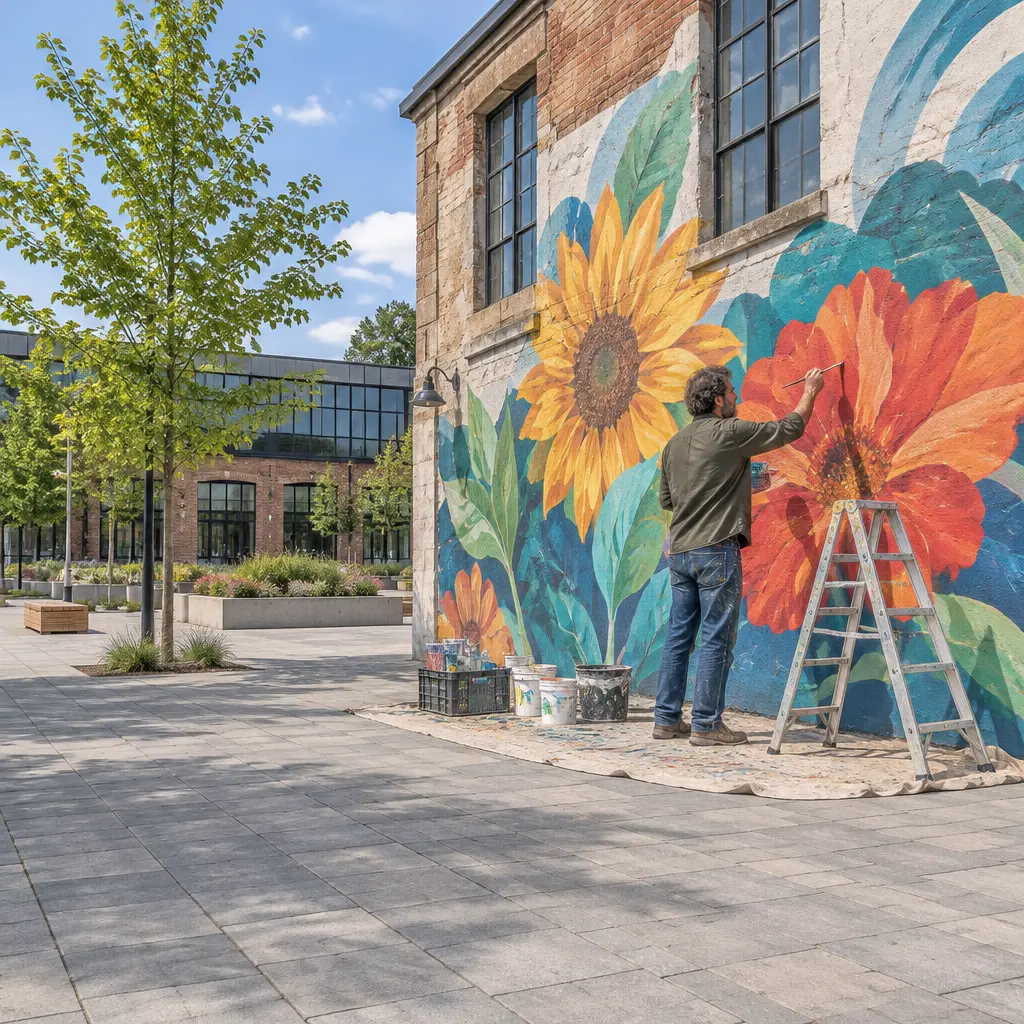
A mural is a large-scale image applied to a wall or other architectural surface. Murals can reflect local stories, commemorate people or events, and make a blank façade visually distinctive. Their social value is strongest when residents help select the subject, artists, and location rather than being treated merely as an audience. Long-term success also depends on permission, surface preparation, weather-resistant materials, and a plan for upkeep.
Philadelphia’s Mural Arts program is a prominent example of organized mural-making connected to public engagement. The program’s history demonstrates how commissions can bring artists and communities together, but a mural’s presence alone does not prove that it reduces crime or improves economic conditions. Such claims require careful evaluation that accounts for other changes in the area.
Temporary installations and public participation
Temporary art includes short-term installations, performances, projections, and pop-up exhibitions. Because it is reversible, it can test how people use a site before a permanent investment is made. Participatory art goes further by inviting the public to contribute ideas, materials, or creative work, potentially broadening local ownership of a project.
For example, an installation in an empty plaza can prompt observation of where people sit, walk, or gather. Project organizers can document attendance, dwell time, participant feedback, and accessibility barriers rather than relying only on photographs or anecdotal enthusiasm. That evidence can inform decisions about whether to retain, adapt, or remove the work.
Creative reuse transforms vacant buildings through new uses
Adaptive reuse is the process of giving an existing building a new function while retaining some of its structure or character. The National Park Service’s guidance on historic building rehabilitation emphasizes compatible new uses and retaining historic features where feasible. Creative reuse applies this approach to arts spaces, studios, galleries, performance venues, cultural centers, and mixed-use projects.
Vacant buildings may offer room for cultural activity, but an empty property is not automatically suitable for public use. Structural condition, contamination, fire safety, utilities, accessibility, ownership, and zoning all affect feasibility. The U.S. Environmental Protection Agency’s brownfields program describes how suspected or actual contamination can complicate reuse; assessment and remediation may be necessary before a site can safely serve the public.
Artist studios, galleries, and cultural hubs
Artist studios and galleries can reactivate buildings by making them workplaces and destinations. A cultural hub may combine exhibition space with classes, rehearsal rooms, workshops, or community services. This mix can spread activity across different times of day and create opportunities for local artists and organizations.
The model requires more than a creative tenant: operators need stable leases, operating funds, insurance, safe building systems, and affordable access. A temporary arts tenancy can bring immediate activity to a vacant property, but it should not be presented as a substitute for permanent repairs or fair compensation. Clear agreements help protect both property owners and participating artists.
Historic reuse and neighborhood continuity
Reusing a former school, factory, warehouse, or civic building can retain familiar architecture while adapting it to contemporary needs. The National Park Service’s rehabilitation standards offer a framework for balancing new functions with historic character. This can conserve embodied materials and preserve a visible connection to local history, although older buildings may require costly upgrades to meet current safety and accessibility standards.
The successful conversion of a vacant structure should be judged by more than its appearance. Useful indicators include the building’s ongoing occupancy, public access, operating costs, local hiring, cultural programming, and whether community groups can afford to use the space. A project that preserves a façade but displaces existing residents or businesses may have mixed results for the neighborhood.
Community-led planning connects art with lasting public benefit
Community-led planning involves residents, artists, local organizations, property owners, and public agencies in decisions about a project. The National Endowment for the Arts’ Our Town program promotes creative placemaking partnerships that integrate arts and culture into community development. The approach recognizes that local knowledge can help identify meaningful stories, practical needs, and potential conflicts before construction or installation begins.
Access, inclusion, and stewardship
Inclusive projects consider who can reach, enter, understand, and use a space. That includes physical accessibility, language access, culturally relevant interpretation, varied programming, and opportunities for people to participate without cost. The Americans with Disabilities Act provides requirements relevant to accessible public facilities; project teams should consult applicable standards during design rather than treating accessibility as a late-stage addition.
Stewardship means assigning responsibility for cleaning, repairs, conservation, security, and future programming. A maintenance plan should identify who pays, who makes decisions, and how the public can report problems. Without these arrangements, a once-valued installation may deteriorate, or a reused building may become inaccessible after its initial funding ends.
Measuring outcomes and managing displacement risks
Evaluation can track both cultural and practical outcomes: attendance, repeat visits, local artist participation, accessibility, building occupancy, program affordability, and resident perceptions. Baseline data collected before a project makes later comparisons more useful. Where possible, evaluations should distinguish a project’s contribution from broader shifts in population, investment, or public policy.
Public art and cultural investment can also accompany rising property interest. That does not mean an artwork alone causes displacement, but it makes housing stability and local access important planning questions. Cities and project partners can consult residents early, support affordable cultural space, monitor rents and business turnover, and connect creative placemaking to broader anti-displacement measures.
Conclusion: Art can renew places when communities shape the process
Public art transforms shared spaces through murals, temporary installations, and participation, while adaptive reuse gives vacant buildings new cultural and civic functions. Research and real-world programs show why these strategies attract interest, but their benefits depend on context rather than artwork alone. Community involvement, safe and accessible design, reliable maintenance, thoughtful evaluation, and attention to displacement risks help turn a temporary burst of activity into lasting public value.
Residents, artists, property owners, and local agencies can begin by identifying an underused place, listening to people who already live or work nearby, and testing a project at a scale the community can sustain. For further reading, consult the National Endowment for the Arts on creative placemaking, the National Park Service on historic rehabilitation, and the Environmental Protection Agency on brownfields assessment and reuse.
Sources: National Endowment for the Arts, The Arts and Culture: Community and Social Outcomes, 2017, https://www.arts.gov/impact/research/publications/arts-and-culture-community-and-social-outcomes; U.S. General Services Administration, Art in Architecture Program, https://www.gsa.gov/real-estate/design-and-construction/art-in-architecture-fine-arts; Mural Arts Philadelphia, About Mural Arts Philadelphia, https://www.muralarts.org/about/; National Park Service, The Secretary of the Interior’s Standards for Rehabilitation, https://www.nps.gov/articles/000/the-secretary-of-the-interior-s-standards-for-rehabilitation.htm; U.S. Environmental Protection Agency, Brownfields, https://www.epa.gov/brownfields; National Endowment for the Arts, Our Town, https://www.arts.gov/initiatives/our-town; U.S. Department of Justice, Americans with Disabilities Act, https://www.ada.gov/.