
Arts Education Programs for Children and Youth
Arts education programs for children and youth provide structured opportunities to learn and create through visual arts, music, dance, theater, media arts, and interdisciplinary projects. They can take place in schools, community organizations, museums, and after-school settings. Research associates sustained arts learning with stronger engagement and opportunities to develop creative, social, and academic skills, although outcomes depend on program quality, access, and context. This article explains the main program types, evidence and benefits, practical design features, and persistent access challenges, drawing on federal data and research reviews.
Arts Education Programs: Definition, Scope, and Evidence
The National Core Arts Standards define arts learning through discipline-specific practices: creating, performing or presenting, responding, and connecting. In this framework, an arts education program is an organized sequence of learning experiences in which students develop artistic knowledge and skills, make or interpret art, and reflect on its meaning. Programs range from classroom instruction and specialist-led courses to ensembles, residencies, museum learning, and community workshops.
Federal data show that access is uneven. The National Endowment for the Arts’ analysis of the 2016 Arts Education in Public Elementary and Secondary Schools survey reported that 97% of public elementary schools offered music and 93% offered visual arts, while dance and theater were available in considerably fewer schools. Availability does not necessarily mean that every student receives regular instruction: course schedules, staffing, funding, and local priorities shape actual participation.
Evidence should be interpreted carefully. The President’s Committee on the Arts and the Humanities’ 2011 review, Reinvesting in Arts Education, described arts learning as supporting cognitive, social, and personal development, while emphasizing the importance of sustained, high-quality instruction. Research findings are not a guarantee that any arts activity will raise grades or test scores; the strongest case for arts education includes artistic learning itself as well as potential benefits that transfer to other areas.
Arts Education Programs Build Skills Through Multiple Disciplines
A program’s discipline determines the materials, techniques, and forms of expression students encounter. The National Core Arts Standards treat the arts as related but distinct subjects, each requiring its own vocabulary, practice, and assessment. Effective programs therefore offer meaningful opportunities to make, perform, present, respond, and connect—not simply occasional exposure to art.
Visual Arts and Media Arts
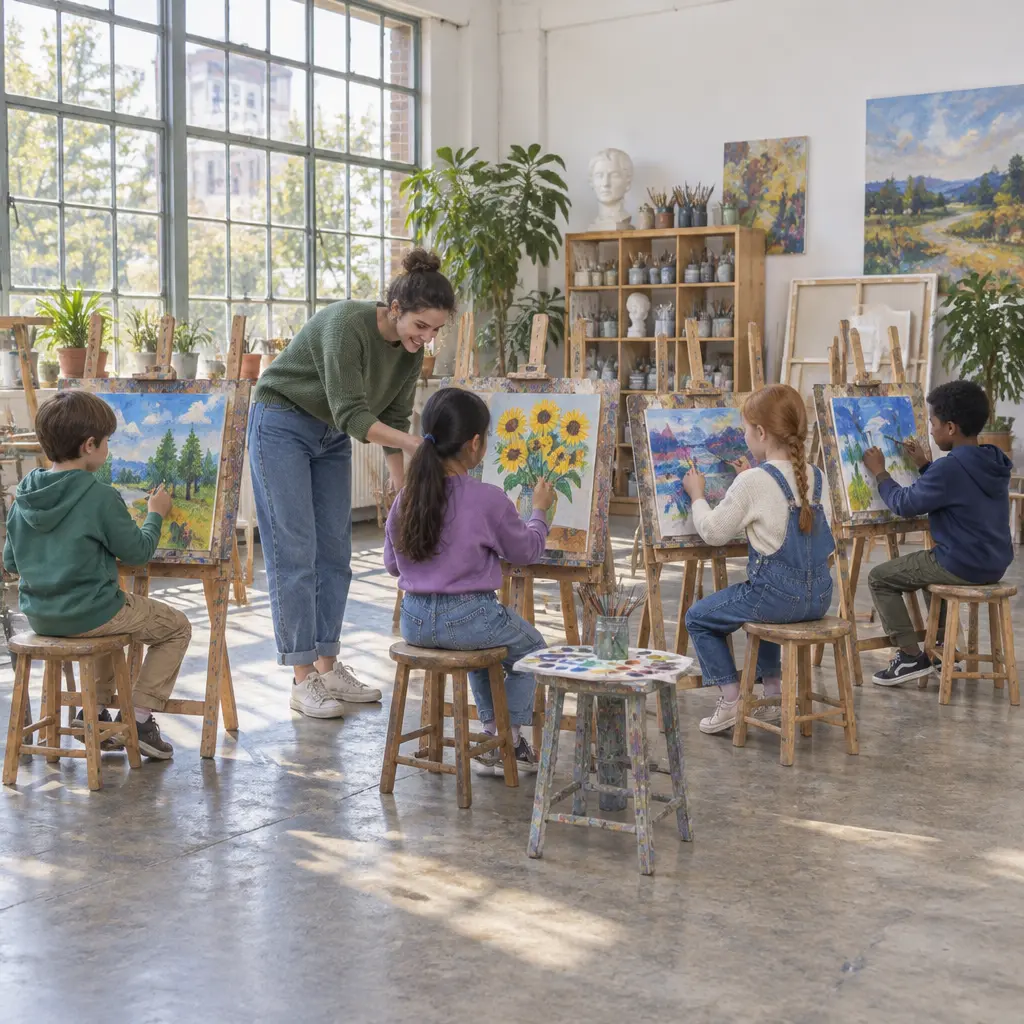
Visual arts programs teach students to create and interpret work using forms such as drawing, painting, sculpture, photography, and printmaking. Media arts extends this learning to tools and formats such as animation, video, digital imaging, and interactive media. Students develop technique and visual literacy while considering how choices of composition, material, audience, and context affect meaning. A community program might, for example, invite young people to produce a photo essay about a neighborhood issue, combining technical instruction with research and reflection.
Music Programs and Ensembles
Music education includes singing, instrumental study, composition, improvisation, listening, and performance. School-based examples include general music, choir, orchestra, band, and contemporary music groups; community programs may provide lessons or ensemble participation beyond the school day. Ensemble work gives learners practice coordinating with others and interpreting shared material, while individual lessons can provide targeted instruction. The National Endowment for the Arts’ school survey found music among the most commonly offered arts subjects in public elementary schools, but access to instruments, specialist teachers, and advanced courses can still vary.
Dance and Theater
Dance programs develop movement, rhythm, choreography, performance, and awareness of the body in space. Theater education may include acting, scriptwriting, directing, design, technical production, and stage management. These disciplines combine individual expression with rehearsal and collective decision-making. A youth theater production, for instance, can give students opportunities to contribute onstage or backstage and to analyze how text, movement, sound, and design communicate a story. Because dance and theater are less consistently available than music or visual arts in many schools, partnerships with cultural organizations can help broaden participation.
Interdisciplinary and Culturally Responsive Arts Learning
Interdisciplinary programs connect artistic practice with subjects such as history, science, language, or civic learning. Culturally responsive instruction recognizes students’ identities, communities, and artistic traditions as resources for learning rather than treating one canon or style as universal. The National Core Arts Standards’ “connecting” process supports this work by asking students to relate art to personal, social, cultural, and historical contexts. For example, students might study local mural traditions, interview community artists, and create work that reflects multiple perspectives.
Arts Education Programs Support Learning and Development
Arts participation can support development through repeated practice, feedback, interpretation, and collaboration. The research base is diverse, and effects vary by age, discipline, program duration, and study design. The National Endowment for the Arts’ 2012 report, The Arts and Achievement in At-Risk Youth, found associations between arts engagement and selected educational outcomes among young people from low socioeconomic backgrounds. Because the report analyzed associations, it should not be read as proof that arts participation alone caused those outcomes.
Creative Thinking and Artistic Skill
Learning to make art requires students to generate ideas, test materials, revise work, and make decisions in response to goals or constraints. These are concrete artistic practices, and they also offer a setting in which students can exercise flexible thinking. Programs should assess artistic growth directly—for example, through portfolios, performances, demonstrations, or reflective statements—rather than assuming that creativity can be measured only through general academic tests.
Engagement, Belonging, and Social Development
Arts activities can create shared purposes and visible roles for learners with different interests and strengths. Rehearsing an ensemble piece, developing a performance, or collaborating on a mural asks students to listen, respond, and contribute. The U.S. Department of Education’s National Center for Education Statistics tracks students’ access to arts courses as part of its broader school-indicator work, underscoring that participation is both an educational opportunity and an equity question. Belonging is not automatic, however: supportive teaching, accessible materials, and respectful treatment of cultural expression matter.
Academic Connections and Evidence Limits
Arts learning may reinforce skills used across subjects, such as observation, interpretation, sequencing, and communication. The President’s Committee on the Arts and the Humanities review discusses research on relationships between arts education and academic outcomes, but findings differ across studies and should be understood in context. Programs are most defensible when they protect time for arts learning as a substantive educational goal, rather than promising quick improvements in test scores or treating arts activities only as a tool for other subjects.
Arts Education Programs Depend on Access, Quality, and Partnerships
A program’s impact depends on who can participate, how instruction is delivered, and whether learning continues long enough for students to develop. The National Endowment for the Arts’ school survey documents differences in subject availability, while local conditions determine whether offerings are frequent, adequately staffed, and open to all students. Equitable design therefore includes both access and quality.
Barriers to Participation
Common barriers include limited school budgets, teacher shortages, fees, transportation, scheduling conflicts, disability-related access needs, and unequal availability between communities. A course listed in a school catalogue may still be inaccessible if it conflicts with required classes or carries costs for supplies and travel. Programs can respond by providing materials, accessible spaces and formats, transportation support, translated family information, and multiple ways to participate.
School, Community, and Cultural-Organization Partnerships
Partnerships connect schools with teaching artists, museums, libraries, theaters, cultural centers, and local arts organizations. The U.S. Department of Education’s 2018 report, Arts in Education: A Review of the Literature, describes program models and research relevant to arts learning in educational settings. Strong partnerships clarify instructional goals, responsibilities, student support, and how learning will be assessed. They can extend learning beyond the school day, but they work best when community expertise complements rather than replaces sustained school instruction.
Program Design and Evaluation
A well-designed program states what students should learn, provides qualified instruction and appropriate materials, and gives students time to practice and reflect. Evaluation can combine participation data with evidence of artistic learning, student and family feedback, and observations of teaching. Useful questions include whether students from different backgrounds can enroll, whether they attend consistently, and whether their work shows development over time. Using these measures helps organizations improve programs without reducing artistic growth to a single number.
Conclusion: Sustaining Arts Education for Children and Youth
Arts education programs encompass visual and media arts, music, dance, theater, and interdisciplinary learning. Federal surveys show that some disciplines are more commonly offered in schools than others, and research reviews identify promising connections between arts participation, engagement, and development while cautioning against simplistic claims of causation. Sustained instruction, skilled educators, cultural responsiveness, accessible design, and strong community partnerships help turn an arts offering into a meaningful learning experience.
Schools, families, and community organizations can strengthen these opportunities by reviewing which students have access, protecting regular instructional time, and supporting qualified arts educators. For further reading, consult the National Core Arts Standards, the National Endowment for the Arts’ arts-education research, and the U.S. Department of Education’s review of arts education literature.
Sources: National Coalition for Core Arts Standards, National Core Arts Standards, https://www.nationalartsstandards.org/; National Endowment for the Arts, Arts Education in Public Elementary and Secondary Schools: 2016, https://www.arts.gov/impact/research/publications/arts-education-public-elementary-and-secondary-schools-2016; President’s Committee on the Arts and the Humanities, Reinvesting in Arts Education: Winning America’s Future Through Creative Schools, 2011, https://www.arts.gov/sites/default/files/ReinvestingInArtsEducation.pdf; National Endowment for the Arts, The Arts and Achievement in At-Risk Youth: Findings from Four Longitudinal Studies, 2012, https://www.arts.gov/impact/research/publications/arts-and-achievement-risk-youth-findings-four-longitudinal-studies; U.S. Department of Education, Arts in Education: A Review of the Literature, 2018, https://www.ed.gov/sites/ed/files/2020/07/Arts-in-Education-A-Review-of-the-Literature.pdf; National Center for Education Statistics, The Condition of Education: Arts Education, https://nces.ed.gov/programs/coe/indicator/cge.